Do not hesitage to give us a call. We are an expert team and we are happy to talk to you.
1.8445.3356.33
Help@goodlayers.com
Our 4-Day Salkantay Trek is an intense and unforgettable journey that combines breathtaking landscapes, local culture, and adventure on the way to Machu Picchu.
Along the route, you’ll visit the stunning Humantay Lake, with its turquoise waters set beneath snow-capped peaks, and hike through the impressive Salkantay Pass, surrounded by the majestic Salkantay Mountain. As you descend, the scenery transforms into lush cloud forest and tropical valleys, offering a rich diversity of flora and fauna.
You’ll also pass through the vibrant Lucmabamba area, where you can experience local life and, in some cases, learn about traditional coffee production from nearby families.
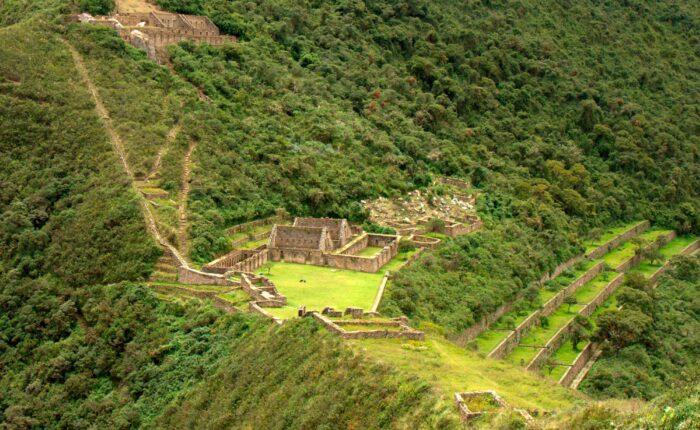
One of the highlights of the trek is hiking a section of the original Inca Trail to the Llactapata ruins, where you’ll enjoy your first panoramic view of Machu Picchu from a unique and less crowded angle.
At night, you’ll rest in comfortable camps or lodges designed to give you a well-deserved break after each day’s adventure.
Your journey concludes with a guided visit to the awe-inspiring Machu Picchu, one of the New Seven Wonders of the World — the perfect ending to an extraordinary trekking experience.
We leave from Cusco between 4:30 and 5:00 am and take a scenic morning bus-ride to our trek starting point at Marcoccasa.
Along the four-hour drive, we will pass through the city of Limatambo (2100 masl/6888 ft), an important point of access to the city of Cusco, where the Tarawasi ruins are located. The road continues up a beaten track along the right shore of the Apurimac River and crossing the city of Mollepata (2800 masl/9184 ft) and the small community of Cruzpata (2750 masl/9020 ft), where is the starting point of the trek and where we meet our wranglers and horses. After a short introduction, we’ll start the hike up through the vegetation in the dark hills.
The beginning of the trail is slopping with some flat stretches, appropriately called the “training section” of the trek. Go at your own pace, this day is more flexible.
If you arrive early enough, you have the option to hike up to the small lake at the bottom of the Humantay Mountain to come back to the campsite called Soraypampa. (3,500 masl/11480 ft).
We will wake up to a beautiful morning in the mountains, have breakfast, and start the hike to the summit of the trail.
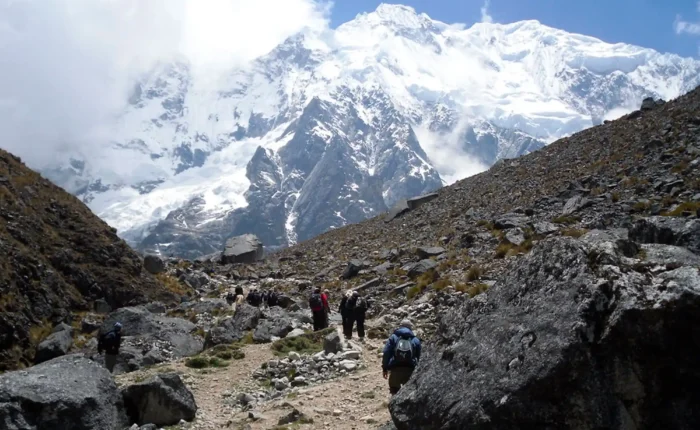
During the ascent we will have our first view of the Salkantay Mountain and we will start our hike towards the base of the white peaks of Salkantay (6271m/20569ft), crossing Salkantaypampa.
Then we have a 2 hr steep ascent to Soyroccocha, just next to the impressive glacier views from the Salkantay pass (4600m/15088ft), the highest pass in the program where, besides enjoying stunning views of the surrounding glaciers and the snow-capped peaks of the Vilcabamba Range, we may also observe chinchillas and condors in their natural habitat.
We will take a break for a mid-trail lunch and from this point, we start descending towards a more tropical climate, into the cloud forest. Along the route, we can see the remains of an ancient Inca path, which is approximately 6 meters wide.
As we continue, we will experience the increasingly lush vegetation, passing by waterfalls, passion fruit and coffee plantations. After the last 3 hour hike we arrive at the settlement of Chaullay, the base camp (2,900 masl – 9,514 ft).
Our early morning starts with a walk towards La Playa, crossing the small village called Collpapampa.
Here, the Salkantay River becomes the Santa Teresa River.
After a rest, we continue our descent to the banks of the Totora River, passing the waterfalls at Coripacchi, to the settlement at Wiñaypoko where there are passion fruit, mango, banana, avocado, and coffee.
At midday, we’ll get to the energetic small city of La Playa and take a break for lunch, and continue the journey in a small bus (1 hour and 30 minutes) until the Hydroelectric.
There you have two options: you can continue by foot for 3 hours or you can catch the 1 hr train (USD 37.00) to finally arrive at Aguas Calientes where we will meet up for an early dinner. We will spend the night in a hostel.
We wake up early and take a bus to Machu Picchu where we begin a complete 2 hour guided tour in the Inca citadel.
You will then have free time to walk around or climb up the Huayna Picchu or Machu Picchu Mountain, where you can observe spectacular views of Machu Picchu from a different angle, the valleys and mountains that surround it (please note that there are only 400 visitors allowed per day for Huayna Picchu and Machu Picchu mountain, USD 75.00, you must reserve it in advance). You may also visit the Temple of the Moon, Sun Gate or the impressive Inca Bridge.
In the afternoon, we will head back down to Aguas Calientes to board the train to Ollantaytambo and a 2 hr bus back to Cusco. Please Note: We always do everything in our power to follow the set itinerary, however it can change occasionally based on temporary park restrictions, campsite availability, weather, road closures, guest ability/injury, and natural events like fires and flooding.
Pre-departure briefing at Willka Travel Office or at your hotel in Cusco.
Entrance for the Salkantay
Pick-up from your hotel in the morning and transfer to Mollepata by bus/van (starting point of the trek)
Personal tents: 2 people in a 4-people-capacity tent, to allow for higher comfort and a safe storage of the backpacks. Our tents are 3-season, highly maintained to ensure an excellent accommodation as requested.
Dining tent with tables and chairs and kitchen tent
English-speaking, professional, and official tourist guide (The standard group size is 13 and 1 guide, with a maximum of 16 customers and 2 guides) (During pandemic times this number can be reduced).
1-night accommodation in Aguas Calientes
Chef and cooking equipment
Pack animals (to carry tents, food, and cooking equipment) – days 1 to 4
Pack animals to carry personal gear up to a maximum of 7 kg per person (including sleeping pad and sleeping bag) – days 1 to 3
Accommodation for our staff
Meals (3B, 3L, 3D + daily morning snack + daily tea service, except for the last day). Vegetarian or special menus are available at no extra cost – please, request it in advance.
First-aid kit including emergency oxygen tank
Machu Picchu entrance fee
Train ticket from Aguas Calientes to Cusco (Touristic Service)
Transfer to your hotel in Cusco at the end of the last day
Clothes, rain gear, and footwear
Sunscreen, toiletries, and personal items
Water bottles and a headlamp or flashlight
Lunch and dinner on the last day after the guided tour at Machu Picchu
Walking sticks
Sleeping bags (you can rent from our company at our agency)
Guide gratuity/tips (recommendation is 10-15% of trip cost).
Backpack with rain shelter.
Sleeping bag.
Clothing for warm and cold climate – waterproof jacket.
Rain pants and lightweight pants.
Rain poncho
Sun and winter hat.
Trekking shoes.
Slippers or sandals (for showers and the hot springs).
Warm socks and a sweater.
Long- and short-sleeved T-Shirts.
Sunscreen, insect repellent, hand sanitizer, water bottle and sterilizing tablets, toiletries and toilet paper.
Camera (wrapped in a plastic bag), a flashlight and batteries.
Some snacks like chocolate bars and dry fruit.
Original passport, original ISIC student card
Extra money insoles (s/ 300.00 soles) emergency case and tips.
Since the weather can be very cold and damp, your clothes will not dry overnight so make sure to bring enough spare ones.
The trek is moderate to challenging. Day 2 is the toughest, reaching the highest point at Salkantay Pass (4,600 m / 15,092 ft). A reasonable fitness level is recommended, along with 1–2 days of acclimatization in Cusco before starting.
Most packages include:
Yes. It’s recommended to book at least 2–4 weeks in advance, especially during high season (May–September), as tickets to Machu Picchu are limited.
The best time is during the dry season (April to October), when weather conditions are more stable and views are clearer.
The rainy season (November to March) is still possible, but trails can be wetter and more challenging.